Not only do some people feel the need to body shame other humans, but some also feel compelled to body shame reptiles as well! Really?!
The first occurrence happened a couple of festivals ago. I was stationed next to a table selling leopard geckos, and I overheard one gecko being described as “chunky.” Really—we’re now calling lizards chunky? I was personally offended for the lizard. Humans are entirely responsible for their care, yet we criticize the reptile? They don’t exactly go to the fridge for midnight snacks!
Okay, this gecko was on the larger side, but maybe she was just big-boned. And as I said, she doesn’t control her own food provisioning. A lizard has got to eat when food is available, so her size was solely the human’s fault. Thankfully, the vendor at least acknowledged who was responsible for the lizard’s weight.
Meeting Alberta in Scottsdale
Fast forward to the All-American Reptile and Plant Show in Scottsdale. I was set up next to the Western State Tortoise Company, where the owner, Tom, brought his eight-year-old female Aldabra tortoise, Alberta (Aldabrachelys gigantea).
Alberta was hanging out right next to me between our tables, and we developed an immediate rapport. In fact, we discussed a book I could write about her (I’m already mapping it out!).
Throughout the weekend, people constantly assumed she was a mere Sulcata (African spurred tortoise). The slightly more informed passersby realized she didn’t quite look like a Sulcata, which got me thinking about a working book title: Don’t Call Me Sulcata! It would fit perfectly into my science-packed books about reptiles, allowing me to put my own unique spin on tortoises of the world. I took a lot of photos of her for the illustrations because I want to be certain she looks her best.
A Giant in the Making
Okay, back to the body shaming. Because she is an Aldabra and not a Sulcata, Alberta is obviously not full-grown. In fact, she is just a baby at eight years old. Yes, eight years out of the 200 years she is expected to live!
At her current age, she weighs about 75 pounds. Aldabras are the second-largest tortoises in the world, standing just a few inches shorter than Galápagos tortoises. When she reaches full adulthood, Alberta will be 5 feet long, 4 feet high, and weigh about 400 pounds (males tend to be even larger). This is a tortoise species that grows a staggering quarter-inch per month! I’m thinking that on boring Saturday nights, you could literally sit and watch Alberta grow.
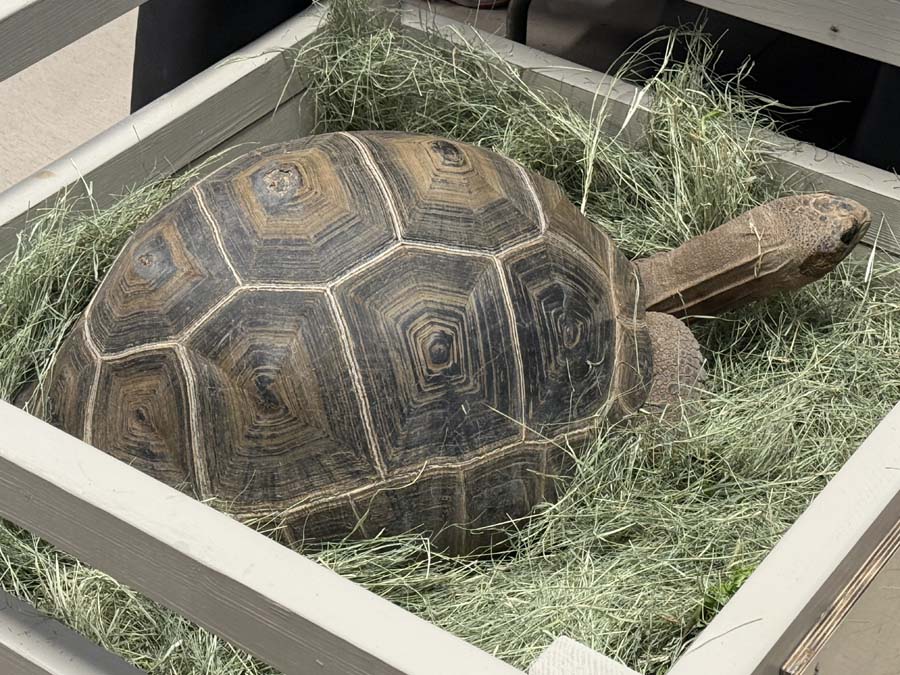
Throughout the weekend, I heard endless claims that Alberta was a Sulcata, and most assumed she was a male, too. Geesh—being mistaken for a different species and the wrong gender? What does a female tortoise have to endure?! Alberta showed her frustration with the crowd by withdrawing her head and turning away. I felt it was my responsibility to step in, help out Tom and Alberta, and educate people about this magnificent giant tortoise species.
Ideal Conditions for a Gorgeous Shell
Alberta is a healthy, appropriately sized Aldabra tortoise. Yet, many people felt the need to mention how she “obviously hadn’t missed many meals” and how large she was for being so young. Wait, what?!
She lives in an excellent environment where she has access to sufficient food, including grazing on grass. Aldabras are native to the Aldabra Atoll in the Seychelles. The Sonoran Desert actually shares a few similarities with their native islands, water scarcity being one. However, the Seychelles have incredibly high humidity, so Tom provides Alberta with a small pond to soak in. Wild Aldabras use mud wallows to cool off, so it’s wonderful that Alberta has similar comforts right here in Arizona. Having these proper conditions allows her to maintain a proper weight, and her shell shape is absolutely excellent.
Just because she’s a member of a large tortoise species doesn’t give humans permission to comment rudely on her weight. Different animals come in different sizes, and in captivity, they should be provided with living conditions that allow them to grow at their normal, healthy rates.
I assured Alberta that not all humans were judgmental. She is trusting me to tell her story to the world, and I intend to do my very best!
Discover the Truth About Desert Reptiles!
Want to help teach the next generation how to respect and appreciate reptiles for exactly who they are? Take a look at Don’t Make Me Rattle, part of my “The Don’t” series, to learn how native desert creatures fit perfectly into our ecosystem.