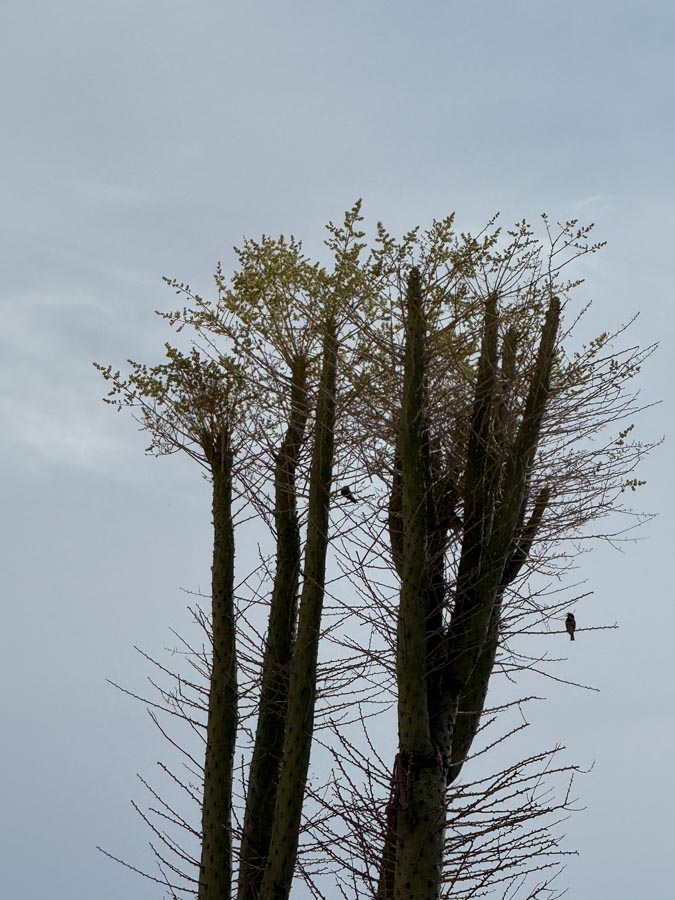
A nearby neighbor has a really interesting plant in their front yard: a boojum tree (Fouquieria columnaris). They used to have two, but sadly one died last year. Boojums are notoriously difficult to grow, so I’m delighted this remaining tree is in full bloom with yellowish flowers—it is just glorious! The tree blooms whether it has rained or not, and fifteen species of bees are known to enjoy its nectar.
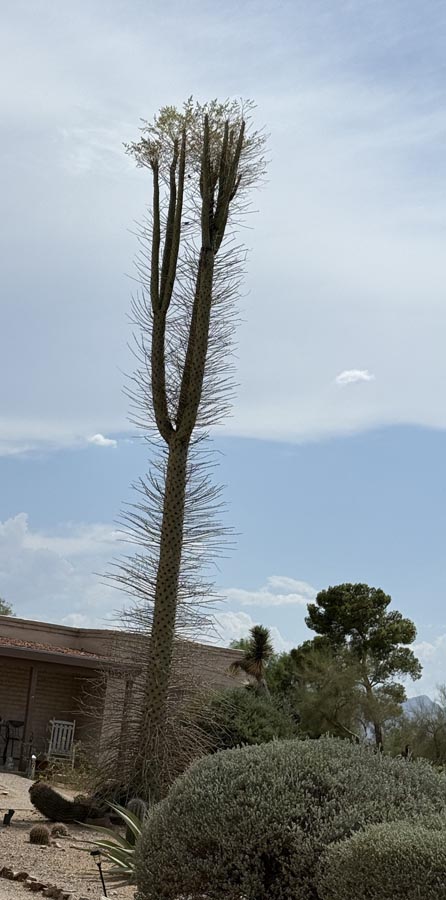
The Giant Upside-Down Carrot
This tall, striking plant belongs to the ocotillo family. Water is stored in its thick trunk, which can reach up to two feet wide. Its tapering top makes the boojum look like a giant upside-down carrot covered with thin, spiny branches and small leaves.
Native to Baja California, it thrives in arid, rocky desert soils—much like those found in my own neighborhood. Under proper conditions, the tree can reach 50 feet in height, with the tallest ever measured standing at an impressive 86.5 feet!
Boojums are also known for their extraordinarily slow growth. A fifty-year-old tree might be only five feet tall. After this initial “rapid” growth, it will only grow about twelve inches per decade! But that slow pace works out fine, as these trees can live for several hundred years.
Poetry, Physics, and Desert Life
How did this unique plant get its name? Which came first: the botanical identification or Lewis Carroll’s poetry? Poetry! The tree was named by explorer Godfrey Sykes after a rather dangerous, mythical creature called a “Boojum” in Carroll’s poem The Hunting of the Snark. I’m not entirely sure why this odd-looking tree reminded Sykes of a creature that causes people to vanish, but the name stuck!
Interestingly, the word shows up in physics, too! In the study of superfluid helium-3, a “boojum” refers to a specific geometric pattern or surface phenomenon associated with vortices. Just as a vortex draws things toward its center, I am definitely drawn to this amazing tree!
Many animals share their lives with the boojum. Hummingbirds regularly visit to sip the nectar from its flowers. Meanwhile, raptors such as red-tailed hawks use the tops of tall, mature trees as perches and nesting sites. Even other plants find boojums useful; coastal lichens (Ramalina menziesii) and ball moss (Tillandsia recurvata) often grow right on the trunks.
The boojum is certainly an odd-looking plant by human standards, but it’s a fascinating species that is masterfully adapted to the hot desert climate of Baja California—and now right here in our own Sonoran Desert.
Curious about how other desert plants and animals adapt to the heat? Explore my science-based picture book Don’t Make Me Rattle! to discover how Sonoran Desert creatures rely on unique adaptations to thrive in their shared habitat!