I like reptiles, including snakes. I grew up with snakes as pets, and there is something smooth and slinky about them that I genuinely enjoy. Sharing photos and videos of the locals slithering through my yard is all part of my effort to educate people about these misunderstood animals. The two snake species I will be talking about in this two-part series are the Western Diamondback Rattlesnake (WDR), Crotalus atrox, and the Sonoran Gopher Snake (SGS), Pituophis catenifer affinis, in Part 2.
I recently posted photos and a video online, and I received quite a few comments. To be honest, I was surprised, and often disturbed, by the reactions.
I am fully aware that I moved into a desert environment rich with native wildlife. At the very least, I believe we should all try to be good co-habitants.
A Surprising Nighttime Encounter
The other night, my 20-pound dog, Max, wanted out to pee. He doesn’t usually ask to go out that late, so I figured he really had to go! Living in a xeriscape desert environment, I usually inspect the yard before letting him outside. There are bobcats, coyotes, and owls that would find Max a nice snack, not to mention Western Diamondback rattlesnakes.
Living in a home full of reptiles (turtles, tortoises, iguanas, and tegus), Max is normally indifferent to them; seeing one outside has no effect on him. That evening, however, Max dashed outside before I had a chance to survey the patio. He leaped out the door and directly onto a snake, then bounded into the yard to find relief.
This is the snake he landed on: a baby Western Diamondback.
The little snake was about a foot long and the width of a pencil. Looking closely, I noticed it had only a button for a rattle. This was a newborn rattler, out exploring the world after completing its first shed. I nudged the little one, but it didn’t respond. I worried Max had flattened it, but I decided to wait and see if it would wander off. (It did!)
Just in case the little rattler took offense to Max’s accidental assault, I gently covered it with a mop that was drying outside so Max could return safely indoors. Soon enough, we all went on our way.

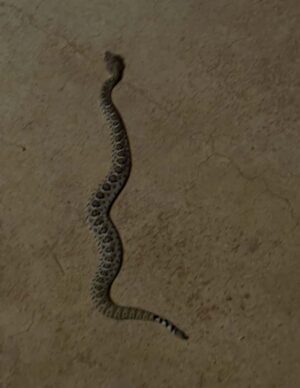
[Baby had completed its first shed based on the button rattle. Rattlers add a segment with each shed.]
Rattlesnake Myths and Curious Comments
Here are a few of the social media comments I received, along with my thoughts:
Comment: “Very lucky he was not bitten by it. Babies can’t control their juice very good so could have been fatal.”
This is a persistent myth. Baby rattlesnakes can indeed control their venom flow. However, even a baby rattler can deliver enough venom to kill a large dog, so I was certainly relieved Max was not bitten. My impression was that the little snake was simply stunned after being stepped on. After all, imagine venturing out on your own after leaving the natal den, only to have a giant mammal jump right onto your back! Not out of malice or fear of a top predator, but simply because he didn’t see you and treated you like an inanimate stick.
Comment: “I can’t tell size or see rattle good enuff. R u sure a baby?”
Yes, the snake was pencil-thin and only about a foot long. I regret not placing a coin or ruler next to it for scale. I went back outside later once I realized I could capture a better comparison photo, but the little guy had already moved on. If you enlarge the photo, though, you can clearly see the single button rattle.
Comment: “Do adult rattlers shake little humans on a stick to keep their tots’ attention?”
I did enjoy the humorous posts! While I doubt baby rattlers play with human toys, they actually do have babysitters to keep them from wandering off before they are ready. Rattlesnake mothers are protective of their young and often receive help from other rattlesnakes. In the snake world, it really does take a village!
A Tale of Two Diamondbacks
Comment: “Looks like a ground rattle we have in Florida.”
The first rattlesnakes I ever met—in fact, my introduction to diamondbacks—were Eastern Diamondbacks (Crotalus adamanteus). As a child, my family frequently traveled down to Sanibel Island. The roads were two lanes with no streetlights. One night during our drive, my father stopped the car, and we all got out to watch a rattlesnake cross the road. She was longer than the road was wide! We were not concerned about safety because she had a noticeable lump in her stomach. I was mesmerized watching her slither peacefully into the tall grass.
Because I grew up seeing those massive Easterns, I am neither surprised nor intimidated by the size of our smaller Westerns. I cannot recall ever hearing an Eastern rattle; there is no need for all that effort when sheer body size is sufficiently effective. Easterns are the largest rattlesnake species in the world, often reaching 8 feet, whereas Westerns generally reach around 5 feet. Westerns, however, sport striking black-and-white “raccoon tail” bands just above the rattle.
Easterns are known for being calmer, but the mother Western who once took up residence in my garage was pretty mellow, too. She didn’t rattle even when I held an identification book picture right up next to her face! Her offspring, on the other hand, were energetic buzzers. Did you know rattlesnakes can rattle up to 50 times per second? Westerns are not easily intimidated by humans, while Easterns definitely prefer their privacy.
Where Is the Mother Rattlesnake?
Comment: “If that is a baby I do not [want to] meet the mother or father.”
Comment: “Where’s the Mama?”
That is a question I have as well. My garage served as a hibernaculum and birthing den for a few years until I sealed up the entry holes. I would have welcomed the rattlers, but they insisted on buzzing at me every time I opened the door to get into my car! I politely encouraged them to explore the numerous ground squirrel burrows around my property instead.
Baby rattlesnakes do not wander far from home during their first excursions, which suggests an active den is nearby. I haven’t spotted any other babies, so I am hoping this was simply one bold explorer. While I have no problem sharing the desert with dens located away from my buildings, I prefer not to have one inside the walled-in backyard where my dog plays. I will definitely be on the lookout. Mothers and daughters tend to return to their natal dens each autumn for winter brumation.
Coexisting with Sonoran Desert Wildlife
Then there were what I consider rather extreme and unrealistic reactions. I live in the Sonoran Desert, and I am the newcomer here. Along with my acre of mostly native xeriscape, I have 26 acres of undeveloped desert next door. I am delighted by the wildlife that wanders across my property.
Comment: “I’d be moving!”
To where? Arizona is home to 13 distinct rattlesnake species! Besides, I enjoy living alongside native reptilian wildlife.
Comment: “Remove it or suffer the consequences. Shovels take their heads right off. Kill it!!”
If you remove and kill a resident snake, another will simply move in. A few years ago, my landscapers removed a medium-sized rattler, only for the territory to be promptly claimed by a large, very gravid female Western! An ecological vacancy always attracts a new resident. I much prefer coexisting with the individual rattlers I know and respect. I also have several other snake species on my property, including kingsnakes that naturally prey on rattlesnakes. I do my best to let nature maintain a balanced, healthy ecosystem.
Comment: “u need the gauge brothers…10 or 12”
This reaction always makes me sad. Why is the default response to wild animals so often lethal force? We are all part of this shared ecosystem, and native snakes, as the original inhabitants, have first rights to live here. Personally, I will take a Western Diamondback over a destructive pack rat any day! (And isn’t discharging a firearm within city limits illegal anyway?)
There were also a few misidentifications (one commenter mistook it for a gopher snake) and some discouraging remarks like, “I like neighbors with legs!” (Does that include giant desert centipedes and tarantulas?). But I was very encouraged by the positive notes: “Beautiful animal!”
I would still love to find where this little rattler’s natal den is located. Observing diamondbacks gathering safely for the winter is an incredible experience; they are truly fascinating creatures.
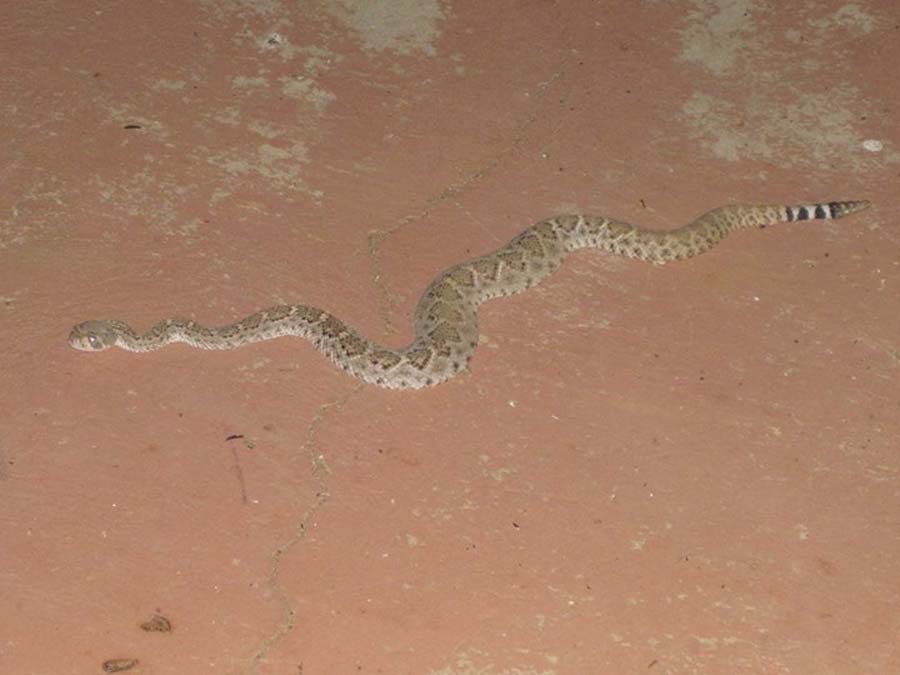
[A Western Diamondback born right in my garage. But that’s a story for another day!]
Respect Rather Than Fear
Rattlesnakes play a vital role in keeping our desert ecosystem healthy and rodent-free. If you want to help young readers understand and respect these marvelous creatures without fear, check out my science-based picture book, Don’t Make Me Rattle! It is an engaging way to introduce children to the rattlesnake’s important place in the wild. Stay tuned for Part 2, where we will meet another commonly misunderstood neighbor: the Sonoran Gopher Snake!