An Unexpected Flutter at My Front Door
It’s late August. The summer monsoon has been so-so—many dry days with an occasional heavy storm, including one night when I got 1.5 inches of rain. For the past couple of days, I’ve been accosted as I exit my house by a flutter of little brown butterflies. A “flutter” is a small, delicate group of butterflies, and yes, this is definitely a flutter. There aren’t enough individuals here to be a swarm or a kaleidoscope.
This flutter is rapid, erratic, and non-stop. I didn’t recognize these butterflies at first, so I was curious to identify them. My energetic insect visitors are Libytheana carinenta, commonly known as the American snout butterfly. Snout? Why would a butterfly be called a snout?
Nature’s Clever Camouflage
This snout butterfly is found throughout North and South America. I’m not sure why I’ve never noticed them before! The name comes from their elongated mouthpart which, along with the antennae, gives the appearance of a petiole of a dead leaf. A petiole is the small stalk that connects the leaf blade to the stem. These butterflies use this unique look as camouflage when hanging upside down under a twig.
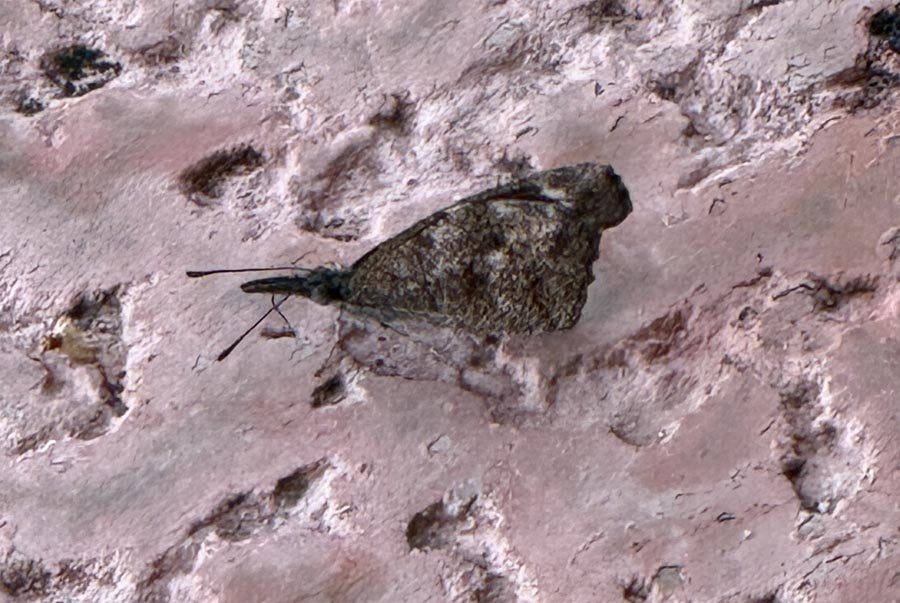
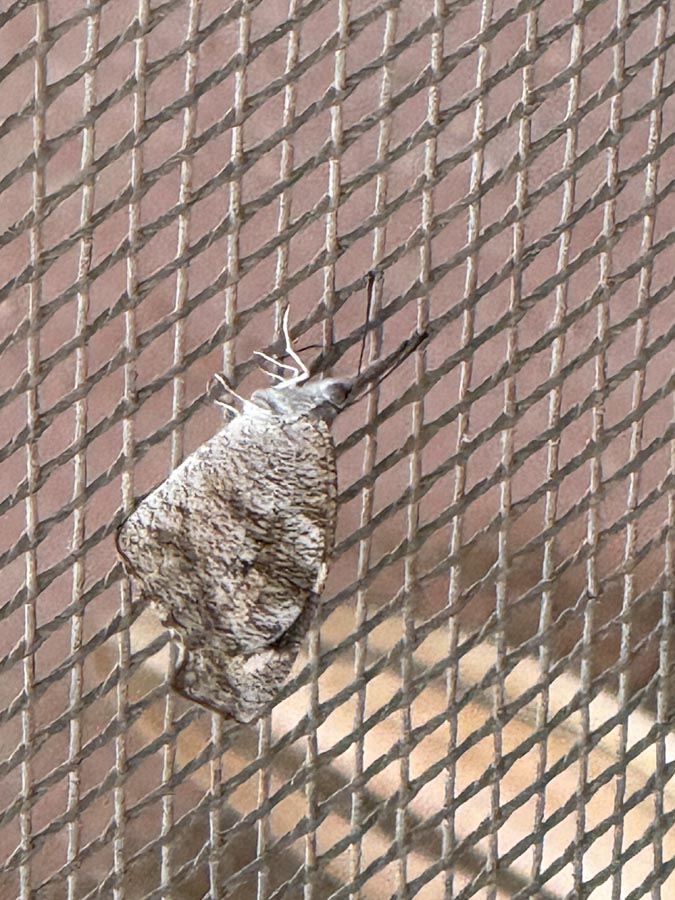
It really does have a snout-looking structure! While I didn’t see any hanging upside down, I did see them flitting about, sitting on the ground, or resting on some netting.
Monsoon Rains and Caterpillar Feasts
So, why am I suddenly being swarmed by little brown butterflies? Heavy monsoon rains cause a sudden population explosion. A recent storm dropped 1.5 inches in a single night—I think that definitely qualifies as heavy rainfall! Of course, all that rain increases plant growth, providing plenty of food for hungry caterpillars.
The caterpillars feed solely on hackberry trees. I’m starting to get more familiar with the hackberry tree species here in the Sonoran Desert, such as the Desert Hackberry (Celtis pallida) and Netleaf Hackberry (Celtis reticulata). The adult butterflies drink nectar from wildflowers and also enjoy fermenting fruit. Consuming fermented fruit might even explain those erratic flight patterns!
I’ve read that millions of adults can emerge at once and move around in massive groups. My group must have been a small subgroup, but migrating swarms elsewhere have actually blocked out the sky! These migrations are triggered when heavy rainfall breaks a drought, which is pretty much a standard summer scenario here in Tucson. The droughts actually help the butterflies because parasites are reduced. Then, the rain signals the adults to emerge, mate, and lay eggs. Having them all emerge at once helps ensure genetic diversity.
I tried to capture a video of the flutter, but all I ended up with were blank scenes. Sigh!
Snouts Around the World
With a name like the American Snout butterfly, I wondered if there were snout butterflies on other continents. In fact, there are! The European snout butterfly, Libythea celtis, is Europe’s only representative of the snout butterfly subfamily. Libythea labdaca is the African snout butterfly, and two species are found in Asia: Libythea lepita and Libythea myrrha. Snouts are worldwide!
I’ve thoroughly enjoyed engaging with these little visitors. However, I really think we could come up with a better name than “snout.” Maybe the more accurate “Elongated Proboscis Butterfly” or even the “Cyrano de Bergerac Butterfly.” Now that has a nice ring to it!
Want to dive deeper into the fascinating creatures that call the Sonoran Desert home? Check out “The Don’t” book series to learn more about our unique local ecosystem.