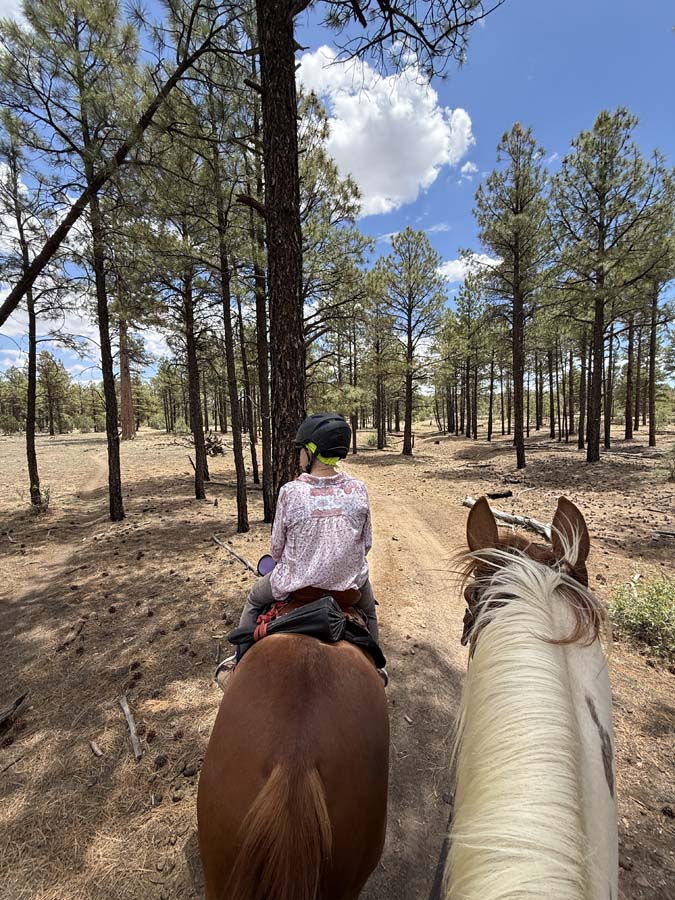
If you regularly read my blogs or follow me on Facebook, you’ll recall that I often haul my horse, Poncho, up to Overgaard, Arizona, to ride in the Apache-Sitgreaves National Forest. My riding buddy has a cabin up in the hills where we’ve set up stalls for Poncho and his best friend, Boogie. The climate there is a refreshing change from the Tucson heat, and the forest environment provides a wonderful contrast to my beloved Sonoran Desert.
It is a place where I find uninterrupted time to write. There is something incredibly inspirational about the sound of horses contentedly munching, birds singing, and the distant call of wolves while I work on my next manuscript.
Encounters with the Heber Herd
When we head out on the trails along the Mogollon Ridge, we particularly enjoy interacting with the Heber herd of wild horses. Over the years, we’ve had incredible experiences with these groups. For the most part, the horses are just as curious about us as we are of them.
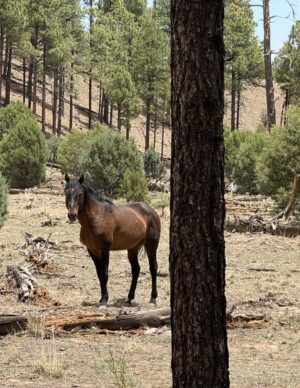
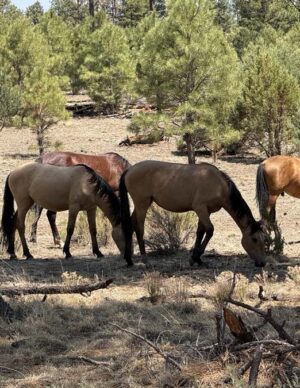
I often think Poncho’s multi-colored pinto coat confuses them, as most of the wild horses have solid-colored coats. Then there are Poncho’s heterochromic eyes (eyes of two different colors). When he turns to face an “uppity” bachelor stallion, they usually back away rapidly! To us, the more wild horses we see, the better the ride.
A Heartbreaking Discovery
Unfortunately, 2026 has started on a somber note for these animals. In January, thirteen horses were found shot to death in the Black Mesa Ranger District—the very area where we ride. It is heartbreaking to wonder if these were horses I had personally met on the trail.
While the Forest Service policy prevents the posting of photos of the deceased animals, necropsies have confirmed the cause of death as gunshot wounds. This isn’t the first time this herd has been targeted; in 2022, over 30 horses were killed in a similar fashion.
The Controversy of “Wild” vs. “Invasive”
The reasons behind these killings remain unknown. Are they the work of people who simply enjoy the cruelty of shooting animals? Or perhaps they stem from the ongoing conflict regarding land use? Wild horses are a controversial topic because they are an introduced species.
Some consider them invasive, while others, like myself, view them as “naturalized.” After all, horses were introduced to this region by Coronado around 1540 and later by Father Kino. They have been an integral part of the ecosystem, history, and culture of the West for centuries. Interestingly, even the honey bees we depend on for agriculture are an introduced species, yet we don’t treat them as villains.
From a biologist’s perspective, I understand the need for population control to prevent starvation during droughts or snowy winters. However, I believe a stable population can be maintained through natural predators, like the wolves and mountain lions found in the forest, and scientific management methods.
A Symbol of the West
The Wild Free-Roaming Horses and Burros Act of 1971 declares these animals to be “living symbols of the historic and pioneer spirit of the West.” Beyond their historical value, they are a significant tourism draw. People travel from all over to catch a glimpse of horses roaming free.
As a member of the IUCN-ISG, I am very familiar with the impact of invasive species. However, when cattle are also grazed in these same areas, one has to ask: why is one introduced species welcomed while the other is targeted?
The shooters have not yet been identified, but the U.S. Forest Service is treating these deaths as a criminal offense. There is surely enough room in our vast forests for these magnificent herds. This summer, Poncho and I will head back up to the Rim to visit his wild cousins, hoping for a future where they can roam without fear.
Want to introduce your children to the animals of the Southwest? Check out my Don’t Make Me Rattle book for a fun, science-based read that teaches kids about the delicate balance of our ecosystems!